The anatomy of a strict explosive muscle up.
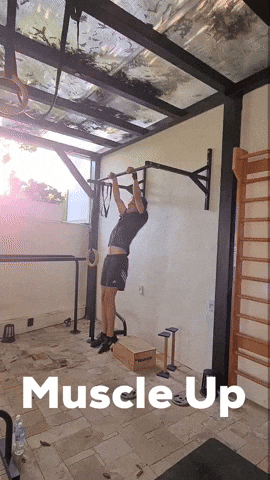
I've watched many hundreds of YouTube videos on the muscle up and how to do one. While I still haven't cracked the muscle up I know exactly what it takes.
Generally people say one can do a muscle up when one can manage 10 pull-ups and 10 dips. I've long been able to hit these numbers, even shortly after starting calisthenics in the Autumn of 2024 I was hitting them. A year later I could manage 25 of both and regularly do 100 pull ups in a session so imagine my confusion when all I'd manage is a jump in muscle up and not even a band assisted muscle up. I tweaked my left shoulder doing higher and higher jump in muscle ups (well above head height) so kind of shelved the idea.
However something kept bugging me... was it was power I was missing or was it technique??? I now have a definitive answer to that.
TL;DR It was mainly power, but also some technique.
Power; The required capacity:
The requirement is not 10, 20, or event 30 pull ups. It's being able to do 1 high bar to belly pull up, with below the ribcage being the target and a peak power of at least 20 W/kg (Watts per kilogram) with 22 W/kg being more usual, and average power of about ~10-12 W/kg
I discovered this with the aid of bands, and using the pull up detector, which can detect a muscle without a pause (I will add the muscle up proper to the app when I someone can help me collect data on the muscle up!)
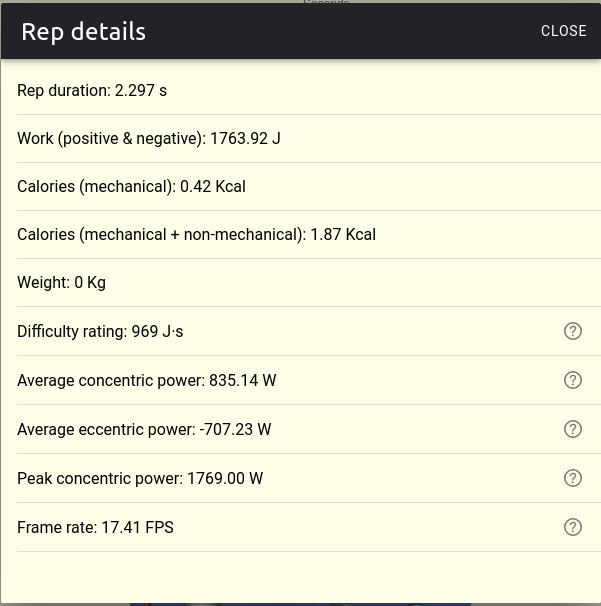
A sloppy banded muscle up that yielded data.
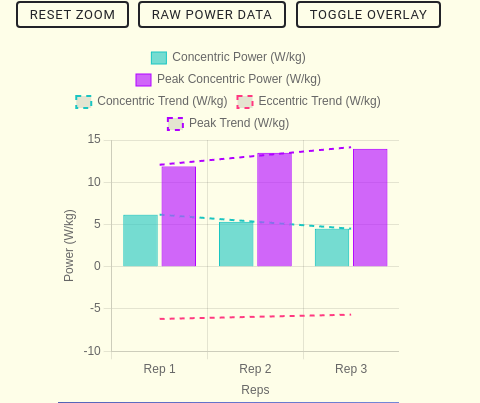
And indeed power is my prime limiting factor... I can sometime get close to these number if I'm fresh on the first rep, but my "standard" explosive pull up is ~6 W/kg.
And it makes sense. I was an endurance athlete for many years, getting top results nationally in long distance triathlon and even racing bikes professionally for 6 years. My muscle fibre type is geared towards high endurance and modest power, while types are categorised (Type 1 (slow oxidative), Type 2a (fast oxidative to glycolytic, Type IIx (fast)) they generally exist on a spectrum.
I'm never going to be remotely "good" at calisthenics because I have low explosive power, plus I'm tall and long limbed. But I love it all the same and the struggle to be "crap" at these skills. It's a fantastic compliment to swimming, running and cycling.
What adaptations are possible to develop the required power?
Fibre type and quantity
Muscle adapts and their type can shift somewhat and power training adds more motor units (typically in sequence rather than in series as in strength training).
Initial changes are observable after ~2 months, but a succinct shift in function takes years. There are strong genetic factors affecting this sort of adaptability as well.
Building more muscle -via myonuclei migration to specific points to build new motor unit connections (specifically neuromuscular junctions, or NMJs), is a process that takes years generally, with a strong genetic ceiling.
The (central) nervous system
The nervous system also adapts, finding ever better paths (and sometimes multiple differents paths) to doing a movement and improving recruitment patterns. This is by far the quickest method and fast improvements in the first few weeks of training a new skill are attributed to it.
Spinal reflexes/responses
With time, reciprocal inhibition (this when opposing muscles fire to stabilize/protect) via specialized nerves called muscle spindles get down regulated allowing one to unlock more force/power.
Tendons and other connective tissues... And more spinal "kill switches"
What's more a hidden limiting factor can be the connective tissues that also respond to training and can limit rates of force production via autogenic inhibition: That is little organelles in the muscles called Golgi Tendon Organ (GTO) work like little biological piezoelectric sensors that when squeezed too hard trigger what's like a "short-circuit" at the spine where an inhibitory neurotransmitter (Spinal Interneuron) is release: Effectively a kill switch so you don't break something accidentally.
These changes can take many months, to years. What's more if you've already got a history of power training or strength training you.
The ideal training to develop the required pull power:
Do pull-ups in very short sets of 2-3 reps with a long recovery (at least 3 min). https://app.swiftmo.com helps because you can see progress in the "explosiveness" and the decay as you tire. This training is exhausting and require a couple of day usually to fully assimilate and recover: Remember you want to hit these warmed up, but otherwise fresh.
Also dips, although these don't need to be explosive. Other movements like the inverted row (normal and piked) can help develop strength through the transition where the elbow have to move back and down.
Technique; The missing link everyone misses:
Raising your legs slightly to shift your center of gravity over the bar synchronously with the movement. That's it. Every single practitioner does this, from the insanely strong gymnasts doing slow muscle ups 🤯, to the a newbie doing sloppy kipping muscle ups: The legs are raised usually in a hinge action. With the proficit athlete this is a subtle and elegant action.
Personally too much swing (or even focusing on the swing) result in a very high pull up, but far from the bar. I found better form, with a very slightly swing.
So:
- Slight swing,
- Belly to bar (using a false grip and scapular retraction),
- Hinge slightly at the hip raising the leg at the top of the pull section, moving your center of mass forward. -this actually what brings the chest over the bar allowing the push action.
Wrapping up
I'm not sure I'll ever get a strict muscle up, I think it's right at the limit of my biological trainable capacity. But I can see I'm progressing and that's keeping me motivated to keep failing 💪.