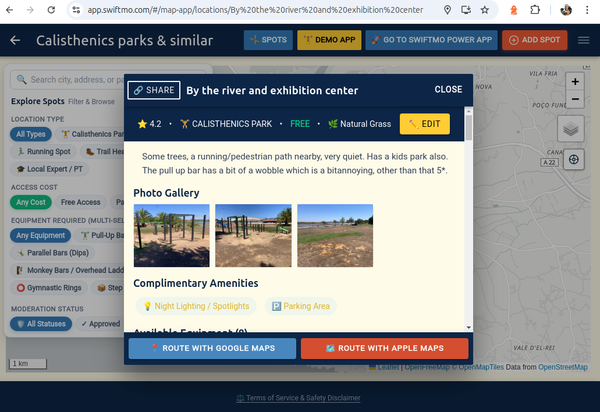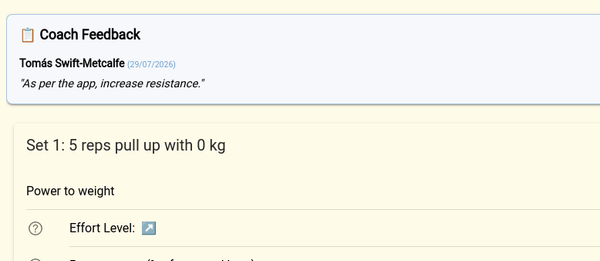
2 years of hard work but it's finally here:
try it out: app
It’s still in beta, and there’s a huge list of improvements on the way, along with general polish and user experience upgrades: but it’s here. My massively ambitious fitness app that tells you how powerful you are.
In April 2024, I came to the realisation that my original hardware solution to the problem this app solves: strength and conditioning training with power, wasn’t going to come together because I simply couldn’t afford the prototype.
But sitting in the back of my mind was an old project from the pandemic: inferring position on a bicycle. It occurred to me that the nuts and bolts of a system capable of inferring power for strength and conditioning could be built using similar principles.
And here we are with the SwiftMo Power app.
I still want to develop hardware—I have so many ideas. When I went to Loughborough University 23 years ago to study Sports Technology, my dream was to build fitness equipment. Life had other plans. I ended up racing bicycles for eight years, then moved into tourism for another ten.
But curiosity never left me.
Why this was serendipitous
This app is exciting because it extracts granular performance data from strength and power training in a way that already feels seamless; and I’m working to make it completely seamless.
That data is unbelievably rich. It opens the door to deeper inference around fatigue, performance adaptation, training plans, recovery, and much more.
I have so many research questions that this app and its users can help answer. I genuinely believe it has the potential to benefit both individuals and, in some small way, humanity.
Two weeks, two prototypes... but two years to MVP
It took me just two weeks to build two working prototypes using two completely different technology stacks. At the time, I thought launching something usable would be relatively quick: I was wrong.
It took nearly two years of training models, building infrastructure, debugging, testing, and then testing some more.
Behind all the AI hype is an enormous amount of tedious work, and often surprisingly simple algorithms. In many cases, the smartest solution isn’t a giant neural network. It’s a small, fast, elegant algorithm applied well, rather than using deep learning as a hammer for every proverbial nail.
My own use: “I haven’t got time to train”
One of the most interesting discoveries I made through building this was about my strength training... At a computer!
Testing the app transformed my own performance. I’m 41, and I’m stronger now than at any other point in my life.
And I wasn’t starting from zero, I still do extreme triathlons, bike racing, and open-water swimming.
I went from barely managing six bodyweight pull-ups to doing six pull-ups with 30 kg added... using my kid as the weight.
And all of that while dedicating no more than 30–40 minutes a day to actual training.
I’m what I call an “alt-tab athlete”—greasing the groove. I replaced coffee breaks with 90 squats.
A cognitive performance enhancer
The benefits went far beyond the physical.
I might spend two hours wrestling with a difficult algorithm until my brain feels completely fried.
Then I open the app. Click, click, click.
Thirty bodyweight squats. BOOM, done. Blood rushing and a slight buzz before debugging some feature. I feel completely turbocharged, and suddenly that difficult algorithm starts flowing as though it’s being channelled from somewhere else.
And that’s one of the biggest lessons here:
Sedentarism isn’t usually a product of circumstance. More often, it’s a product of not having an immediate requirement to move.
But the reality is that we are designed to be physically active and mentally active too.
It's still in BETA, but I'd love for you to try it out: app